Note
Click here to download the full example code
3D Animation
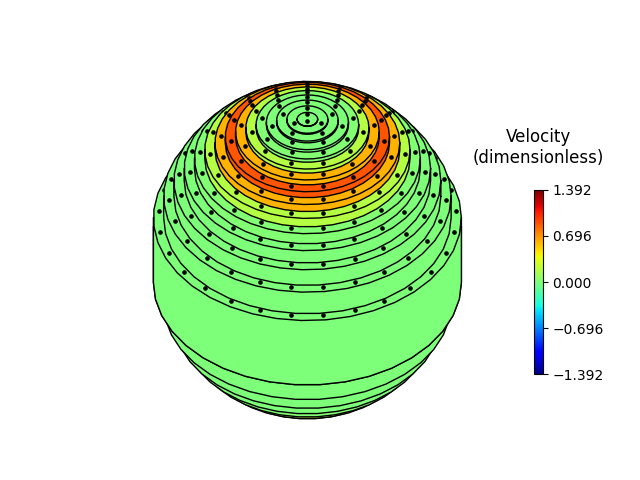
Example of creating a 3D animation of the Cox et al. (2013) torsional oscillations.
import numpy as np
import scipy.interpolate
import matplotlib.pyplot as plt
import sys
sys.path.append('../') #So taco_vis.py is visible to import

from taco_vis import FLOW
Read in Cox et al. (2013) dataset
data_file = "../cox_etal_2013.txt"  # Data file
data = np.genfromtxt(data_file, delimiter=",")
Regrid the data down (too high resolution to be practically plotted as is)
r, t = np.linspace(0, 1, data.shape[0]), np.linspace(0, 1, data.shape[1])
time, radius = np.linspace(0, 1, 2000), np.linspace(0, 1, 16)

func = scipy.interpolate.RectBivariateSpline(r, t, data)
u = func(radius, time)
Initialise FLOW class
f = FLOW(u)

# Up the speed of texture advection
f.speed = 5

f.time = np.linspace(0, 20, time.size)
f.title = "%.2f years"
f.colorbar_title = "Velocity\n(dimensionless)"
Animate
f.plot_cylinders_3D(animate=True)
Out:
/home/docs/.pyenv/versions/3.7.9/lib/python3.7/site-packages/numpy/core/_asarray.py:136: VisibleDeprecationWarning: Creating an ndarray from ragged nested sequences (which is a list-or-tuple of lists-or-tuples-or ndarrays with different lengths or shapes) is deprecated. If you meant to do this, you must specify 'dtype=object' when creating the ndarray
  return array(a, dtype, copy=False, order=order, subok=True)

Animating...
Total running time of the script: ( 0 minutes 8.553 seconds)